What Product Idea Validation Means
Someone has an idea that feels obviously useful. They describe it to a few people, who agree it sounds good. Encouraged, they spend six months and a large part of their savings building it — then discover that the people they built it for are perfectly content doing things the old way.
The build was not the mistake. Starting it without evidence was.
To validate a product idea is to gather evidence that a real group of people has a real problem and will act — sign up, trial or pay — to solve it. It is the cheapest work in the whole product journey, and the most often skipped.
Belief sounds like
“Every clinic in the city struggles with no-shows, so they will want this.”
“Twelve people told me it is a great idea.”
Evidence sounds like
“Nine of the fourteen clinics I visited already pay someone to call patients, and four asked to be told when this is ready.”
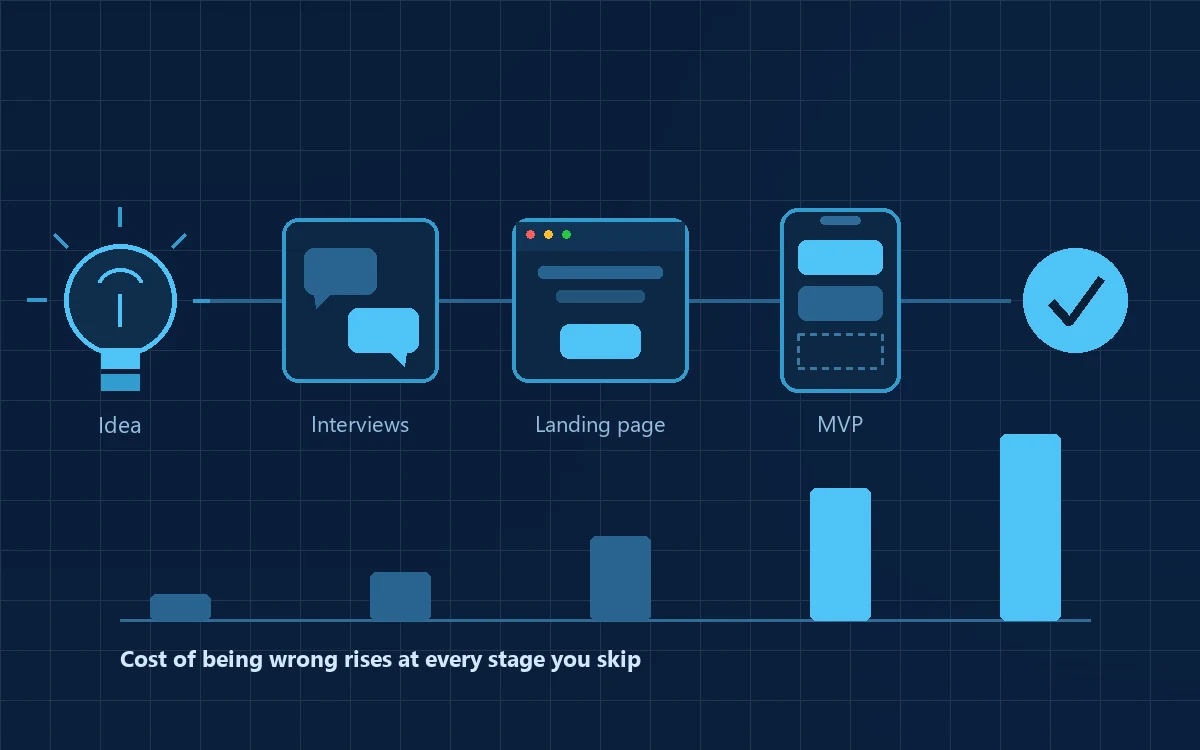
Belief is comfortable and free. Evidence is uncomfortable and cheap. Development is comfortable and expensive — which is why the order you do them in decides what a wrong assumption costs you.
Why Validate Before Building
A wrong assumption caught in a conversation costs an afternoon. Caught after launch, it costs the build, the months and the opportunity.
Validating first gives you seven things:
- Lower development cost — a shorter feature list, built once
- Reduced business risk — capital committed against evidence, not optimism
- A real understanding of the problem — usually more specific than you assumed
- A defined target audience — the segment feeling the pain most
- An early read on willingness to pay — the line between an idea and a business
- A sharper concept — customer language reshapes positioning
- Fewer unnecessary features — first feature lists always carry a few
What validation is not. It reduces uncertainty; it cannot remove it, and no amount of it guarantees commercial success. The honest claim is narrower and still worth a great deal: validation stops you spending heavily on a problem that does not exist.
Step 1 — Define the Problem
Founders describe solutions; customers experience problems. Write the problem your product solves in one sentence, without naming your product in it. A strong statement says who has it, what gets in the way, and what it costs them today.
Weak problem statements
“There is no good app for small retailers.”
“Schools need better technology.”
“Logistics is inefficient.”
Strong problem statements
“Retailers in the market track credit sales in a notebook, lose track of who owes what, and write off dues every quarter.”
“Coaching centres re-enter the same student data into attendance, fees and messaging separately, costing an administrator hours each week.”
If it could describe a hundred businesses equally well, it is a category, not a problem. Keep narrowing until someone reads it and says, that is exactly what happens to me.
Step 2 — Identify Your Target Customer
“Everyone” is not a target market; it is the absence of one. A product for everyone has no particular reason to exist for anyone, and nowhere to look for its first hundred users. Define an ideal customer profile:
- Who exactly has this problem — role, business type, size, location?
- How often do they meet it: daily, monthly, once a year?
- What does it cost in time, money, errors or missed revenue?
- How do they solve it today, and what do they spend on that?
- Who decides on a purchase, and who actually uses the product?
- Where can you reach fifteen of them this month?
The last question is the practical test. If you cannot name where your customers are — a trade association, a WhatsApp group, an industrial estate — you cannot validate, and later you cannot sell either.
Step 3 — Talk to Potential Customers
Highest return, lowest cost, most often replaced by a survey. Aim for fifteen to twenty conversations with people who genuinely have the problem; twenty minutes each is enough. One rule governs them: ask about the past, not the future. People predict their own behaviour badly and report last week accurately.
Avoid these questions
“Would you buy this?”
“Do you think this is a good idea?”
“Would you pay for it?”
Each invites politeness, and politeness is not data.
Ask these instead
“Walk me through the last time this happened.”
“What did you do about it?”
“What did that cost you, in time or money?”
“Have you tried to fix it before? What happened?”
Listen for two things: whether they have already spent money or effort on a fix, and whether they raise the problem before you describe your solution. Both indicate real pain. Enthusiasm indicates good manners.
Step 4 — Research Existing Alternatives
Founders often hope to find no competitors. An empty market is more often a warning: either the problem is not painful enough to pay for, or others tried and withdrew. Competition proves people already spend money here. Find the gap, not the void.
- Direct competitors — same problem, same customer. Study their pricing tiers and what sits behind each one.
- Indirect alternatives — Excel, WhatsApp, a notebook, an extra employee. Usually your real competition.
- Customer complaints — reviews and support forums name unmet needs in the customer's own words.
- Strengths and gaps — what you must match, and which segment or workflow they serve poorly.
Leave this step able to answer one question: why would someone switch? Marginally better is rarely reason enough. Meaningfully better at one thing that matters usually is.
Step 5 — Write a Value Proposition
Compress what you have learned into one sentence a stranger can understand.
The template: For [target customer], who has [problem], our product helps them [solution or benefit].
Worked example: For coaching centres with 100–500 students, who lose administrator hours re-entering student data into attendance, fee and messaging systems, our product keeps one student record that updates all three.
Two tests. Read it to someone outside your industry — if they need a follow-up explanation, it is not ready. Then read it to a potential customer: if they ask how it works rather than what it is, it has landed.
This sentence then becomes your landing page headline, the scope boundary for your MVP, and the line your first salesperson uses.
Step 6 — Test With a Landing Page
A single page can test demand long before a product exists. It states the problem, presents the value proposition, and asks for one specific action. That action is the test — choose the strongest one your stage supports.
| Call to action | What it tells you |
|---|---|
| Join the waitlist | Lowest friction, weakest signal. Good for gauging interest volume. |
| Register interest | More commitment if you ask for context, not just an email address. |
| Book a consultation | Giving up time is a meaningful business-to-business signal. |
| Request a demo | Strong intent, and it produces conversations. |
| Pre-order or deposit | The strongest signal available before a product exists. |
Send a small amount of targeted traffic — a modest ad budget, relevant groups, an industry association, your network beyond friends and family. Then compare what people say with what they do. A page 500 people visited and eleven acted on tells you what a hundred conversations could not. Our comparison of static and dynamic websites covers the cheapest way to put one up.
Be straightforward about stage. If the product is not built yet, say so. “Join the early access list” is honest and still converts. A page implying a product exists costs you the trust of the people you most want as first customers.
Step 7 — Build an MVP, Not the Full Product
A minimum viable product is the smallest working version that tests your core assumption with real users — not a demo, and not a trimmed-down version of everything, but the one workflow carrying the value.
The discipline is in what you leave out. Take a field-service platform imagined with scheduling, GPS tracking, inventory, invoicing, a customer portal, analytics and four roles. The assumption underneath is far simpler: will technicians record job completion on a phone instead of calling the office?
The full product as imagined
Eight modules, four roles, web and mobile, dashboards and integrations. Months of work before anyone outside the team uses it.
The MVP that tests the assumption
One mobile screen where a technician marks a job done with a photo, and one web view where the office sees it. Two roles.
If technicians use it, you have earned the right to build the rest. If not, you learned that for a fraction of the cost, and from behaviour rather than opinion. Scope discipline here is where product development saves the most money.
Step 8 — Test With Real Users
Give the MVP to ten to thirty people who genuinely have the problem — not colleagues, investors or family. Then watch rather than ask. Set a real task and stay quiet. Where do they hesitate? Which step do they abandon?
Someone who says “this is very good” while taking four minutes over a thirty-second task has told you two contradictory things. Believe the stopwatch.
- Observe a first session unaided, in person or over a screen share
- Check week two — day-one usage is curiosity; returning is interest
- Ask what they used before, and whether they have stopped
- Count repeat requests before building anything someone asks for
Step 9 — Measure the Right Signals
Feedback is an opinion; a metric records what someone did. Positive feedback alone does not prove demand — a signal is only as strong as what it cost to give.
| Signal | What it means | Strength |
|---|---|---|
| Landing-page sign-ups | Cheap to give, easy to gather. Directional, not conclusive. | Weak |
| Interviews completed | Valuable for insight; a poor measure of demand on its own. | Weak |
| Demo requests and bookings | Costs the customer time, which raises signal quality. | Moderate |
| Trial users completing the core task | Behaviour, not intention. The first reliable indicator. | Moderate |
| Repeat usage after week two | The clearest evidence of a recurring problem being solved. | Strong |
| Pre-orders, deposits, paying customers | Money is the least ambiguous answer to “do you want this?” | Strong |
Two more to track early. Willingness to pay — quote a price and watch the reaction rather than asking what someone would pay. And customer acquisition cost: if reaching one customer costs more than they are worth, the problem is the business model, not the build.
Ten people who pay tell you more than a thousand who approve.
Step 10 — Build, Modify or Stop
Validation is only useful if you will act on all three answers. Set your criteria before you see the results — it is easy to reinterpret weak evidence once you are attached to an idea.
| Outcome | What you saw | What to do |
|---|---|---|
| Continue building | A consistent problem across interviews, people acting rather than agreeing, and a segment you can reach affordably. | Proceed with the MVP scope, not the full list. |
| Modify or pivot | The problem is real but the customer, workflow or price was wrong. The most common outcome, and the most useful. | Adjust one variable and retest. |
| Stop or postpone | People acknowledge the problem but will not change behaviour or pay for a fix. | Stop. This is not failure — it is the return on the validation work. |
Finding this out now costs weeks. Finding it out after launch costs the build, the runway, and the months you could have spent on the next idea.
Common Validation Mistakes
Almost every one of these is a way of collecting agreement instead of evidence.
- Asking only friends and family — they are answering about your feelings, not your product.
- Treating likes as demand — social approval costs nothing to give.
- Building too many features — each adds cost and delays the moment you learn anything.
- Ignoring competitors — you lose the pricing benchmark and what customers already reject.
- Targeting everyone — no first user, and no place to start selling.
- Spending heavily too early — big commitments before evidence remove your options.
- Ignoring pricing until later — price is part of the product. Test it while changing it is free.
- Confusing compliments with commitment — “very useful, send me the link” is not a customer. A calendar invite is closer.
A Practical Validation Checklist
Work through this before approaching any development company. Arriving with these answers changes the conversation from “what could we build?” to “what should we build first?” — which usually reduces both scope and cost.
- Problem clearly defined — one sentence, no mention of your solution
- Target customer identified — a specific segment you can name and reach
- Customer interviews completed — ideally 15–20, about past behaviour
- Competitors researched — direct, indirect and the do-nothing alternative
- Value proposition defined — one sentence a stranger understands
- Landing page or test campaign created — one clear call to action
- Customer interest measured — actions recorded, not opinions collected
- Pricing hypothesis tested — a number quoted to real prospects
- MVP scope defined — the one workflow that tests the core assumption
- Success metrics established — decided before the results arrive
When to Bring in a Development Partner
Much of validation is deliberately low-tech, and founders should run the customer conversations themselves — the nuance in those answers shapes the product. Professional help becomes worthwhile once the questions turn technical:
- MVP development — scoping and building the smallest testable version
- UI/UX design — flows, wireframes and screens users can navigate
- Technical feasibility — whether the hard part can be built, and at what cost
- Architecture — decisions that determine what phase two will cost
- API integrations — payments, messaging, ERP, third-party systems
- Web and mobile applications — dashboards, portals, multi-role platforms, offline-first apps
- Scaling an MVP — extending a validated product without rebuilding it
A useful test when choosing a partner: does the conversation start with your problem, or with a technology stack? A team that proposes building less in phase one is thinking about your product.
M PRO9 works with entrepreneurs, MSMEs and organisations across web, application and AI development and custom software. Our approach to idea-to-product work follows the same logic as this article: understand the problem, build the smallest thing that proves something, extend on evidence. If you should validate further before writing code, we will say so.
What we do not claim. No partner can guarantee product-market fit, funding, customer acquisition or revenue — and any firm offering such a guarantee is worth questioning. What a technology partner can offer is clear thinking about scope, honest feasibility advice, and a product built in an order that keeps your options open.
Conclusion
The decision to validate a product idea before building is not caution — it is sequencing. You will spend the money either way. The only question is whether you spend it before you know what customers need, or after.
Start small. Write the problem in one sentence. Speak to fifteen people who have it. Put up one page and see who acts. Build the smallest thing that answers your riskiest question, and let behaviour rather than compliments decide what comes next.
Ideas are plentiful. Evidence is what makes one worth building.