What Is a Static Website?
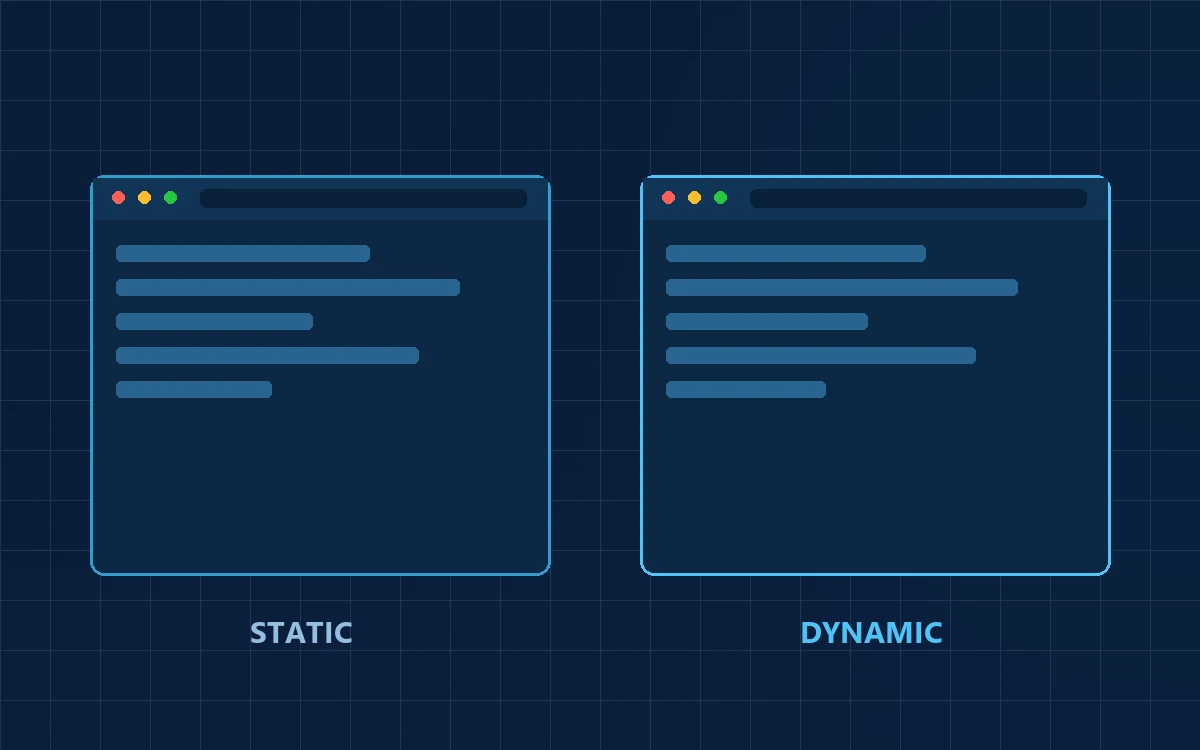
A static website is a set of HTML, CSS, JavaScript and media files that are built once and served exactly as they are. When a visitor requests a page, the server sends the file. No database is queried, no code runs on the server, nothing is assembled.
“Static” describes how pages are delivered, not how they look or behave. A static site can have animation, 3D content, forms, search and interactive filtering — all of it running in the visitor's browser. The M PRO9 site you are reading is itself static.
What Is a Dynamic Website?
A dynamic website assembles each page on the server at the moment it is requested. The server runs application code, queries a database, applies the visitor's identity and permissions, and returns HTML built for that specific request.
This is what makes personalisation, user accounts, live inventory and role-based dashboards possible. It is also why dynamic sites need more infrastructure: an application runtime, a database, and ongoing patching of both.
A useful test: if two different visitors should see different content at the same URL at the same moment, you need dynamic behaviour somewhere in the stack.
Direct Comparison
The trade-offs are consistent enough to tabulate:
| Factor | Static | Dynamic |
|---|---|---|
| Page delivery | Pre-built file served directly | Assembled per request |
| Typical load time | Very fast — no server work | Depends on queries and caching |
| Hosting cost | Low; often a CDN alone | Higher; runtime plus database |
| Attack surface | Minimal — nothing executes server-side | Larger — app code, database, dependencies |
| Content updates | Rebuild and redeploy, or a headless CMS | Edit through an admin interface |
| Personalisation | Client-side only | Full, per user and per session |
| Scaling under load | Effectively free | Requires capacity planning |
When Static Is the Right Choice
Choose static when the same content should be visible to everyone:
- Company and brand websites. Service pages, about pages, case studies.
- Campaign and landing pages. Where load speed directly affects conversion and ad quality scoring.
- Documentation and knowledge bases. Content that changes on a release cycle rather than continuously.
- Blogs and editorial sites. Including this one.
The performance advantage is not marginal. A static page served from a CDN typically responds in tens of milliseconds because there is no application logic between the request and the response. That matters for search ranking, for paid traffic, and for visitors on slow mobile connections.
When Dynamic Is Necessary
Dynamic behaviour is required — not merely convenient — when any of these apply:
- User accounts and authentication. Login, sessions, permissions.
- Transactions. Checkout, payment, order state.
- Live data. Inventory, pricing, availability, telemetry.
- Role-based interfaces. Dashboards and admin panels where what you see depends on who you are.
- Frequent editing by non-technical staff. Where a rebuild step would be a real obstacle.
The hybrid case
Most real projects are not one or the other. A common and effective pattern is a static marketing site with a dynamic application on a subdomain or path — the public pages stay fast and cheap, while the portal gets the runtime it needs. This keeps the highest-traffic pages out of the application's blast radius.
Cost, Security and Maintenance
The build cost of a static and a dynamic site of similar visual scope is often comparable. The difference shows up over the following years.
A static site has essentially no runtime to patch. There is no database to back up, no dependency tree receiving security advisories, and no application server to keep current. Hosting is inexpensive and scales without intervention.
A dynamic site carries ongoing obligations: framework and library updates, database backups and restore testing, capacity monitoring, and a meaningfully larger attack surface. These are all manageable — but they are real recurring costs that should be in the budget from day one, not discovered in year two.
Conclusion
The question is not which technology is better; it is how much of your site genuinely needs to differ per visitor. Content that is the same for everyone should be static, because static is faster, cheaper and safer. Content that depends on who is asking needs a dynamic layer.
Start by listing the pages your business actually needs, and mark which ones change per user. If that column is empty, a static build will serve you better and cost less to run. If it is not, scope the dynamic part deliberately rather than making the whole site dynamic by default.