Research That Leads
to Real Systems
We explore emerging technologies, validate ideas through engineering, and transform research into practical products, platforms, and intelligent technology systems.
Our approach
Research grounded in
engineering reality.
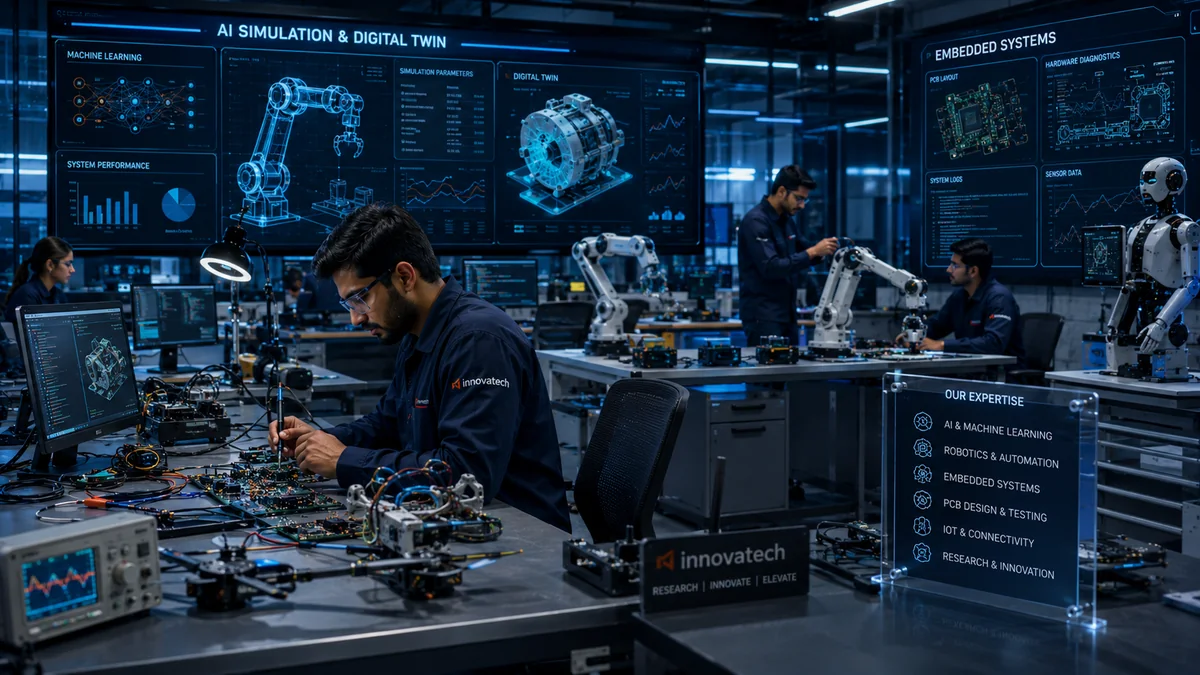
We do not separate research from building. Every exploration at MPRO 9 moves through a defined process — from problem framing through engineering validation to working systems. Ideas that cannot survive contact with hardware and real constraints are refined until they do.
- Problem before technology We define the problem precisely before selecting any tool or approach. The right technology follows from the right question.
- Build to learn Prototypes are how we test assumptions. Nothing replaces measured results from real hardware operating under realistic conditions.
- Honest evaluation If an approach does not work, we say so and redirect. Good research requires accurate feedback, not optimistic projections.
- Engineering toward deployment Research outcomes connect to deployable systems, not just demonstrable prototypes. The path from concept to product is part of the process.
Research Focus Areas
Five technical domains where MPRO 9 actively explores, builds, and validates.
AI & Machine Intelligence
Edge AI inference, embedded machine learning, anomaly detection, and vision model integration on constrained hardware — not just cloud-dependent systems.
Robotics & Machine Vision
Custom robotic systems, collaborative automation, computer vision for detection and classification, and sensor-actuator integration for practical operational environments.
Embedded Systems & IoT
Firmware development, sensor interfaces, wireless connectivity across BLE, Wi-Fi, and LoRa, and low-power device prototyping for connected system applications.
AR/VR & Spatial Computing
Augmented reality for industrial and educational contexts, immersive simulation environments, and spatial product visualisation where physical and digital information merge.
3D & Digital Fabrication
Rapid prototyping workflows, additive manufacturing processes, and the engineering path from 3D model to physical system — bridging design and production.
Prototype to Product
How research becomes a working, deployed system. For the wider commercial view of the same journey, read our guide to the idea-to-product development process.
Research
Identify the problem, explore existing approaches, evaluate technical feasibility, and define the direction before committing resources.
Validation
Test core assumptions with minimal builds. Confirm the approach works under realistic constraints before full engineering begins.
Prototype
Build a working system that demonstrates function under real conditions — enough to learn from and expose what must be refined.
Product
Engineer the prototype for reliability, the deployment environment, and integration with adjacent systems and infrastructure.
Deployment
Deliver, test in environment, and stay engaged. Real operating conditions reveal what controlled testing cannot — iteration continues after launch.
Current Exploration Areas
Active engineering and research directions at MPRO 9.
On-Device AI for Resource-Constrained Systems
Deploying AI inference models on microcontrollers and edge hardware where cloud connectivity is unavailable or impractical — enabling intelligent behaviour at the device level without latency or dependency on external services.
Multi-Sensor Fusion for Automation
Combining vision, proximity, environmental, and motion sensor data into coherent decision inputs for automated systems — improving reliability in environments where single-sensor approaches fail or produce ambiguous results.
Real-Time Digital Twin Prototyping
Building synchronised digital representations of physical systems to accelerate testing, identify failure modes, and validate design changes before they are applied to hardware — shortening iteration cycles significantly.
Spatial Interfaces for Industrial Applications
AR overlays and spatial interfaces that surface operational data directly in the physical working environment — reducing the cognitive distance between information and the system it describes, without requiring attention away from the work.
Have a research or technology challenge?
We explore ideas through engineering — turning questions into working systems.