What Is AI Automation?
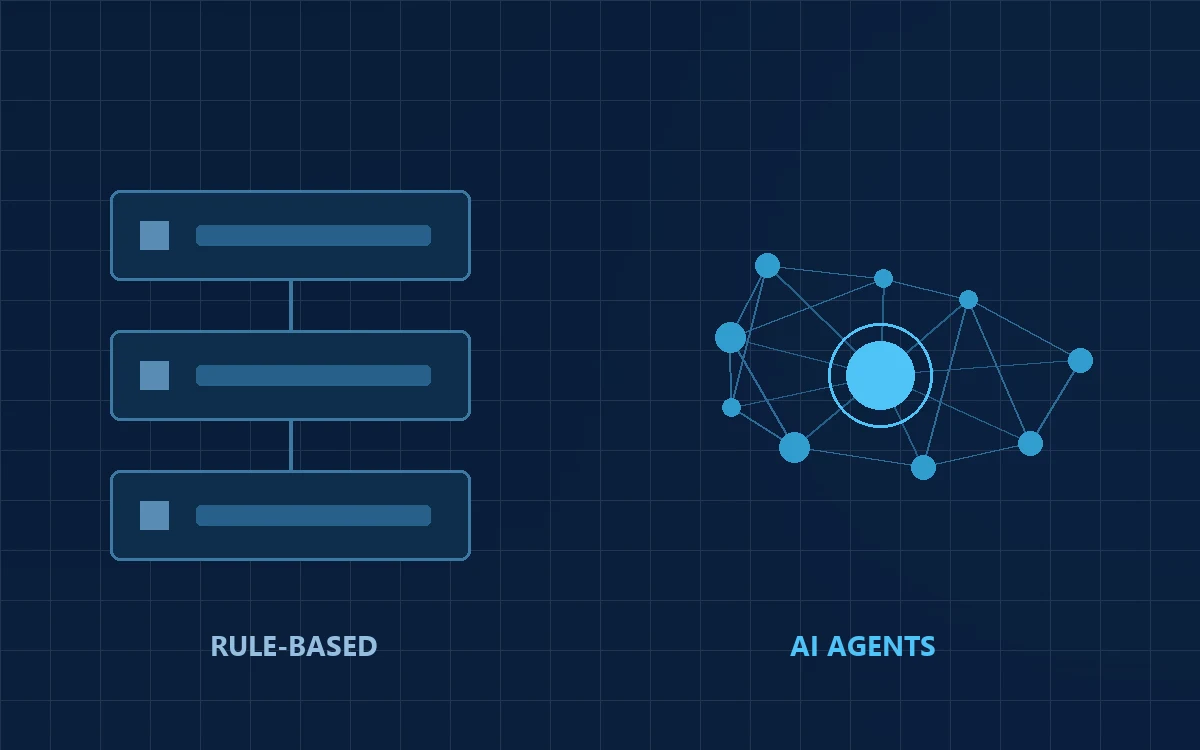
AI automation is the use of machine learning and language models to handle work that previously needed a person to read, interpret or decide something. It sits one level above traditional automation: instead of following a fixed script, the system can work with information that is messy, unstructured or slightly different every time.
A traditional automation script can move a file from one folder to another on a schedule. An AI automation can open that file, understand that it is an invoice, extract the supplier name and total, flag that the amount does not match the purchase order, and route it to the right person with a short explanation.
The practical distinction: traditional automation repeats a decision someone already made. AI automation makes a judgement inside a boundary you define.
How Does AI Automation Work?
Most working systems follow the same four stages, regardless of the underlying model:
- Input. Something arrives — an email, a form submission, a scanned document, a sensor reading, a support ticket, a photograph.
- Interpretation. A model converts that raw input into structured meaning: which category it belongs to, which fields it contains, what the sender is asking for.
- Decision. Business rules are applied to the structured result. This layer is usually deliberately conventional code, because it is the part you need to audit.
- Action. The system writes to a database, updates a record, sends a reply, triggers a downstream process, or escalates to a human.
The important design choice is where the boundary sits between stages three and four. In well-built systems, the model proposes and the rules dispose. Confidence thresholds decide what proceeds automatically and what a person reviews.
Human-in-the-loop by default
Early deployments should route a meaningful share of cases to a reviewer. That review data is what tells you where the model is reliable and where it is not, and it is how you justify raising the automation threshold later.
Common Business Applications
The processes that benefit most share three traits: high volume, low variation in intent, and a clear definition of a correct outcome.
- Document processing. Invoices, purchase orders, delivery notes, forms and contracts — extracting fields and validating them against existing records.
- Customer communication triage. Classifying incoming email or tickets by intent and urgency, drafting a first response, routing to the right team.
- Data reconciliation. Matching records across systems that use different naming, formats or identifiers.
- Reporting and summarisation. Turning raw operational data into a readable weekly summary, with the exceptions highlighted.
- Quality and inspection. Visual checks on production output, covered in more depth in our article on computer vision in industrial automation.
Key Benefits
Measured honestly, the returns tend to appear in four places:
- Reclaimed time. Staff move from data entry to exception handling, which is both higher value and less error-prone.
- Consistency. The same input produces the same classification at 9am on Monday and 6pm on Friday.
- Faster cycle times. Work that queued overnight can be processed as it arrives.
- Visibility. An automated pipeline is instrumented by definition. You get volume, latency and error-rate data that manual processes rarely produce.
What AI automation does not reliably deliver is headcount reduction in the first year. The realistic first-year outcome is the same team absorbing more volume with fewer errors.
Implementation Considerations
Most automation projects fail for organisational reasons, not technical ones. Before building, work through the following.
Start with a process you can measure
If you cannot state the current volume, average handling time and error rate, you will not be able to prove the automation worked. Pick a process where those numbers already exist.
Define what a wrong answer costs
A misrouted support ticket is cheap. A misread payment amount is not. The cost of an error should determine your confidence threshold and how much human review you keep in place.
Plan for data access early
In practice, the longest part of most projects is not the model — it is getting clean, permitted access to the systems that hold the data. Involve whoever owns those systems from the start.
Keep an audit trail
Log the input, the model output, the confidence score and the final action for every case. This is what lets you diagnose a bad decision six months later, and it is increasingly a compliance requirement.
How M PRO9 Approaches Automation
We treat automation as an engineering project rather than a model-selection exercise. In practice that means:
- Process mapping first. We document the existing workflow, its volumes and its failure modes before proposing any technology.
- A narrow pilot. One process, one team, a defined success metric and a fixed review period.
- Deterministic guardrails. Business rules, validation and thresholds stay in conventional code so they can be read, tested and audited.
- Staged autonomy. Every case is reviewed at launch. The automation threshold rises only when the review data supports it.
- Handover. Your team gets the monitoring dashboard, the runbook and the ability to adjust thresholds without calling us.
Conclusion
AI automation is most valuable when it is applied narrowly and measured properly. The technology is no longer the limiting factor — the limiting factors are process clarity, data access and a realistic view of what a wrong answer costs.
Start with one high-volume, well-understood process. Keep a person in the loop until the data says you can step back. Instrument everything. The organisations getting real returns from automation are not the ones that deployed the most models; they are the ones that picked the right first process and measured it honestly.