What Traditional Automation Does
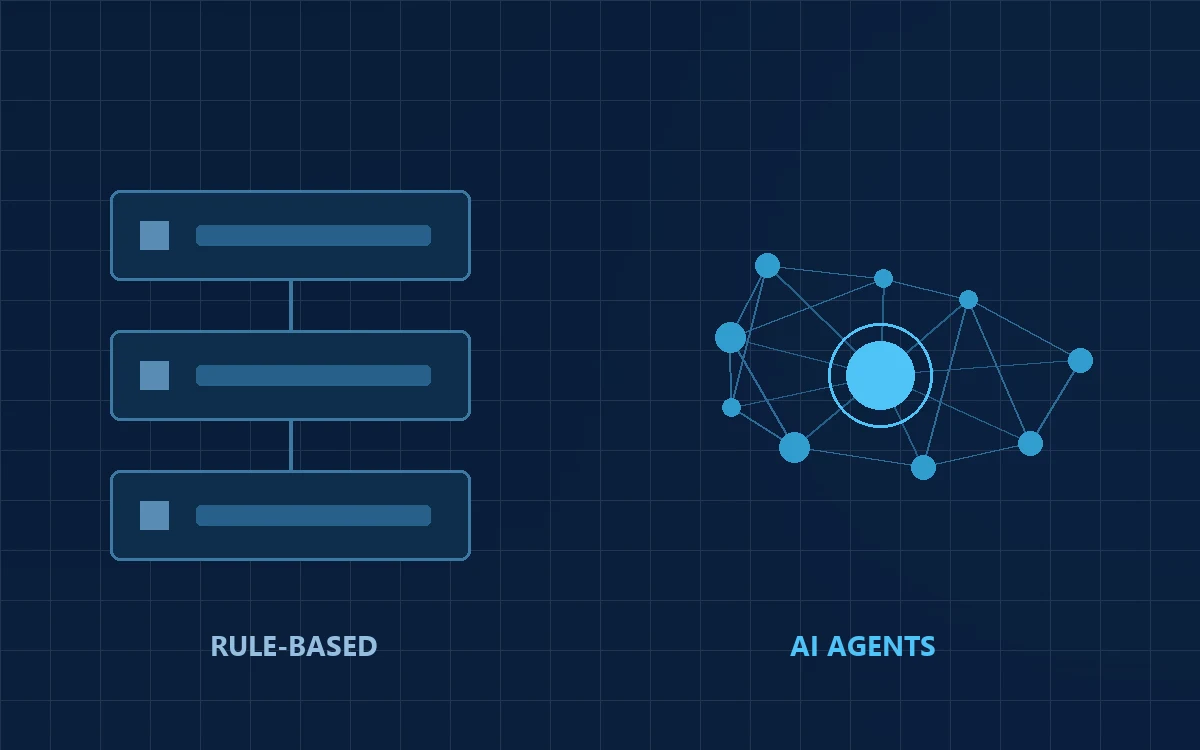
Traditional automation executes a predetermined sequence. An engineer analyses a process, encodes the steps and the decision points, and the system follows that path every time.
This covers a very large amount of valuable work: scheduled data transfers, form validation, document generation, system-to-system integration, robotic process automation over legacy interfaces, and PLC control on production lines.
Its defining property is determinism. Given the same input, it produces the same output, every time, and you can read the code to know in advance what it will do. That is not a limitation to be overcome — for most business processes it is exactly the required behaviour.
What an AI Agent Does
An AI agent is given a goal rather than a procedure. It has access to a set of tools — APIs, databases, search, file operations — and it decides at run time which to use, in what order, based on what it finds.
The operating loop is: assess the current state, choose an action, execute it, observe the result, and repeat until the goal is met or a limit is reached.
Concretely, a rule-based system asked to resolve a delivery query follows a fixed script: look up the order number, read the status field, send the matching template. An agent given the same query might check the order system, notice the tracking number is missing, query the carrier API directly, find the shipment was delayed at a depot, and compose a reply explaining that — a path nobody wrote in advance.
Direct Comparison
| Dimension | Traditional automation | AI agents |
|---|---|---|
| Instruction style | Explicit steps | Goal plus available tools |
| Handling variation | Fails or escalates | Adapts within its tool set |
| Predictability | Fully deterministic | Variable between runs |
| Cost per execution | Negligible | Meaningful — model inference per step |
| Latency | Milliseconds | Seconds to minutes |
| Testing | Standard unit and integration tests | Evaluation sets and statistical thresholds |
| Debugging | Read the code path | Inspect the reasoning trace |
| Failure mode | Stops visibly | May proceed confidently and incorrectly |
The failure modes differ in kind, not degree. Rule-based automation fails loudly and stops. An agent can fail quietly and continue — which is why observability and boundaries matter far more in agent systems.
When Traditional Automation Is Correct
Choose rules whenever the process allows it. Determinism is valuable and inexpensive.
- The process is stable and fully specified. If you can write the flowchart, do not use an agent.
- Errors are expensive. Financial postings, regulatory submissions, safety interlocks and control systems need guaranteed behaviour.
- Volume is high and margins are thin. Per-execution inference cost matters at scale.
- Latency is tight. Sub-second responses rule out multi-step reasoning.
- An audit trail must be reconstructable. “The code did X because line 40 says so” is far stronger than a probabilistic explanation.
When Agents Earn Their Cost
Agents are worth their complexity when the process genuinely cannot be enumerated in advance.
- Input is unstructured and varies widely. Free-text requests, mixed document formats, incoming correspondence.
- The required steps depend on what is discovered. Investigation and research tasks where the next action follows from the last result.
- The rule set would be unmaintainably large. When the exceptions outnumber the main path and every edge case needs its own branch.
- Synthesis across sources is required. Pulling from several systems and producing a coherent summary.
- The output is reviewed before it acts. Drafting, triage and recommendation are lower-risk than direct execution.
The Hybrid Architecture Most Systems Need
In production, the useful question is rarely which approach to adopt but where the boundary between them sits. The pattern that works:
- Rules handle the main path. The 80–90% of cases that are well understood run deterministically, cheaply and fast.
- An agent handles exceptions. Cases the rules cannot classify are routed to the agent rather than straight to a person.
- Rules validate every agent output. Whatever the agent proposes passes through conventional validation before anything is committed. Schema checks, range checks and business constraints stay in ordinary code.
- Confidence thresholds govern autonomy. High-confidence results proceed; everything else escalates to a human.
- Every decision is logged. Input, tool calls, reasoning trace, output and final action — retained and reviewable.
This keeps the cheap, fast, auditable path handling the bulk of the volume, while the expensive and flexible path absorbs the variation that would otherwise land on a person. The same principle underlies our broader approach to AI automation in business operations.
Conclusion
AI agents are not a replacement for traditional automation, and treating them as one produces systems that are slower, more expensive and harder to trust than what they replaced.
The discipline is to keep as much of the process as possible deterministic, and to deploy agents only where the variation genuinely defeats rules — with validation, thresholds and logging around them. Well-designed systems look boring in the middle and intelligent at the edges, and that is the correct shape.