What Is the ESP32?
The ESP32 is a microcontroller family from Espressif that integrates a processor, Wi-Fi and Bluetooth on a single chip. It arrived as the successor to the ESP8266 and has since become the default starting point for a very large share of connected product development.
The reason is integration. Before the ESP32, adding Wi-Fi to an embedded product typically meant a separate radio module, extra board area, an additional supplier and a certification effort. The ESP32 collapses that into one part — and pre-certified modules remove much of the regulatory work as well.
Why It Became the Default
1. Integrated wireless
Wi-Fi and Bluetooth (including BLE) on-chip, in modules that already carry FCC, CE and other regional certifications. For a small team, inheriting a pre-certified module removes one of the most expensive and slowest steps in bringing a wireless product to market.
2. Genuine processing capability
Dual-core operation at up to 240 MHz with several hundred kilobytes of RAM is far beyond what classic 8-bit microcontrollers offer. That headroom allows TLS, local signal processing, a filesystem, an embedded web interface and even small machine-learning models to run on the device.
3. Comprehensive peripherals
Multiple SPI, I2C, UART, I2S and CAN interfaces; ADC and DAC; PWM; touch inputs; and a hardware timer set generous enough that most designs never need an external expander.
4. Cost
Module pricing is low enough that the integrated radio is effectively free relative to a discrete alternative — a decisive factor at production volume.
5. Ecosystem and documentation
ESP-IDF is a mature, well-documented, FreeRTOS-based SDK. The Arduino core lowers the barrier for rapid prototyping. Between them, most integration problems a team will hit have already been encountered, discussed and solved publicly.
Choosing the Right Variant
“ESP32” is a family, not a single part. Picking the right member matters.
| Variant | Wireless | Best suited to |
|---|---|---|
| ESP32 (original) | Wi-Fi + Bluetooth Classic + BLE | General purpose; needed when Bluetooth Classic is required |
| ESP32-S3 | Wi-Fi + BLE | Vector instructions for on-device ML; USB OTG; camera work |
| ESP32-C3 | Wi-Fi + BLE | Cost-sensitive single-core designs; RISC-V |
| ESP32-C6 | Wi-Fi 6 + BLE + 802.15.4 | Thread and Matter smart-home products |
| ESP32-S2 | Wi-Fi only | Designs with no Bluetooth requirement |
For most new connected products, the S3 or C3 is the better starting point than the original ESP32 — unless Bluetooth Classic is specifically required.
Where the ESP32 Is the Wrong Choice
Being the default does not make it universally correct.
Long-life battery products
This is the most important limitation. Wi-Fi is power-hungry: transmit currents in the hundreds of milliamps make sustained operation on a small battery impractical. Deep sleep is efficient, but a device that must wake and transmit frequently will not run for years on a coin cell. For those applications, a low-power MCU paired with a LoRaWAN or BLE-only radio is the appropriate choice.
Safety-critical and certified systems
Applications requiring functional safety certification generally need microcontrollers with the supporting documentation, tool qualification and lifecycle guarantees that safety standards demand.
Hard real-time determinism
Wireless stack activity introduces timing jitter. Where microsecond-level determinism is required, a dedicated real-time MCU — or a companion MCU handling the time-critical work — is a sounder architecture.
Rule of thumb: if the product runs from mains or a rechargeable battery and needs Wi-Fi, the ESP32 is very likely correct. If it must run for years on a primary cell, it very likely is not.
Practical Development Guidance
Use pre-certified modules, not bare chips
Unless volumes are very high, use a module such as the ESP32-WROOM or WROVER family. You inherit the antenna design, the RF layout and the regulatory certification — three things that are genuinely difficult to get right independently.
Respect the antenna keep-out
Module datasheets specify a copper-free zone around the antenna, ideally overhanging the board edge. Ignoring this is one of the most common causes of poor wireless range in first-revision hardware, and it is not fixable in firmware.
Provision the power supply for peaks, not averages
Wi-Fi transmit bursts draw substantially more current than the idle figure. An undersized regulator or insufficient bulk capacitance produces brownouts that present as random reboots and are frequently misdiagnosed as software faults.
Build OTA update in from the start
The ESP32 supports over-the-air updates well, with dual application partitions and rollback. Design the partition table and update path in the first firmware version — retrofitting it to deployed devices is far harder.
Use secure boot and flash encryption for production
Both are supported in hardware. They are straightforward to enable during development and awkward to add once units are in the field.
From Prototype to Production
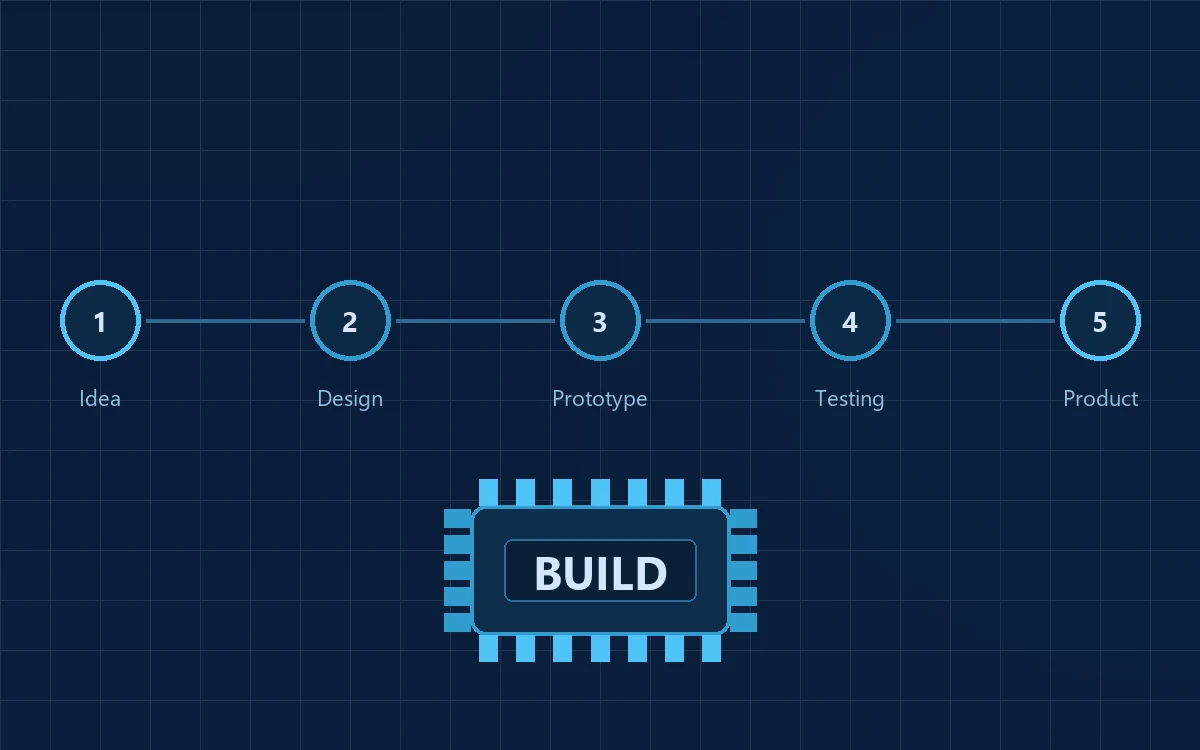
A common pattern is to prototype on a development board with the Arduino core, then move to custom hardware and ESP-IDF for production. That transition is smoother when planned:
- Keep hardware access behind a thin abstraction layer so application logic survives the move to a custom board.
- Match the module variant early. Prototype on the same variant you intend to ship — pin availability and peripheral sets differ across the family.
- Design provisioning before the first production run. How each unit receives its unique credentials and Wi-Fi configuration is an operational problem, not a firmware detail. Our article on IoT system architecture covers the wider fleet considerations.
- Plan test access. Test points and a programming header on the production board make factory flashing and functional test possible.
Conclusion
The ESP32 earned its position by removing the two hardest parts of building a connected product for a small team: integrating a certified radio, and having enough processing headroom to run modern security and application code on the device.
It is the right default for mains-powered and rechargeable connected products. It is the wrong choice for multi-year primary-cell operation, safety-certified systems and hard real-time control. Confirm which category your product is in before the schematic starts — that single decision shapes the rest of the design.