Quick answer: Black soldier fly larvae turn organic waste into feed protein and fertilizer, but only when temperature, humidity and air quality suit the life stage they are in. VivaTraq is M Pro9’s IoT system that senses those conditions continuously and adjusts heating, humidification and ventilation on its own, stage by stage. It has completed prototype validation and is now progressing into trials with live BSF.
Organic waste is one of the hardest materials for cities and businesses to manage, and one of the most valuable when it is handled well. Black soldier fly (BSF) farming turns food scraps and agri-residues into protein-rich larvae and nutrient-rich frass, but only when the insects are kept in the right conditions. That is exactly the gap automated black soldier fly farming is designed to close.
At M Pro9 Private Limited, we are developing VivaTraq, an IoT-based environmental monitoring and automated control system for BSF rearing. VivaTraq continuously tracks conditions inside a rearing chamber and adjusts heating, humidity and airflow on its own, stage by stage, so operators spend less time checking instruments and more time scaling their operations.
Key takeaways
- Black soldier fly larvae turn organic waste into valuable feed protein and organic fertilizer, but their performance depends on temperature, humidity, ventilation and air quality.
- Each stage of the BSF life cycle (egg, larva, prepupa, pupa and adult) needs different conditions, which makes manual control slow and labor-intensive.
- VivaTraq senses chamber conditions continuously and automatically controls heating, humidification and ventilation to match the selected life stage.
- Operators monitor, control and review the chamber from a mobile app, with alerts and historical trends.
- VivaTraq has completed prototype validation and is now progressing into trials with live BSF.
Why black soldier fly farming is gaining momentum
Food waste is a problem on a massive scale. According to the UNEP Food Waste Index Report 2024, the world generated around 1.05 billion tonnes of food waste in 2022, nearly a fifth of all food available to consumers, and households accounted for most of it. In India, household food waste alone is estimated at about 55 kg per person per year. Much of this material still ends up in landfills, where it produces odor, leachate and methane.
This is where the black soldier fly (Hermetia illucens) stands out. BSF larvae are efficient bioconverters that can be reared on a wide range of organic waste streams, turning them into high-value biomass for animal feed and fertilizer (El Deen et al., 2023). On average, dehydrated BSF larvae contain about 42% crude protein on a dry-matter basis, according to Feedipedia, although the exact level depends on what the larvae are fed. That makes them a valued ingredient for poultry, aquaculture and pet feed. The residue left behind, known as frass, can be used as an organic fertilizer; one study found its NPK content comparable to commercially available organic fertilizers (Arabzadeh et al., 2022).
The result is a circular, waste-to-value model: less organic waste sent to landfill, and new inputs for agriculture and animal feed. Little wonder that black soldier fly farming is drawing growing interest from entrepreneurs, waste processors and agri-businesses. It sits alongside the wider circular-economy work we support for local bodies and processors.
The challenge: BSF are highly sensitive to their environment
Raising black soldier flies successfully takes much more than feeding them waste. Their growth, survival and productivity are strongly influenced by temperature, humidity, ventilation and air quality, and there is no single “right” setting. Each stage of the BSF life cycle has its own environmental needs.
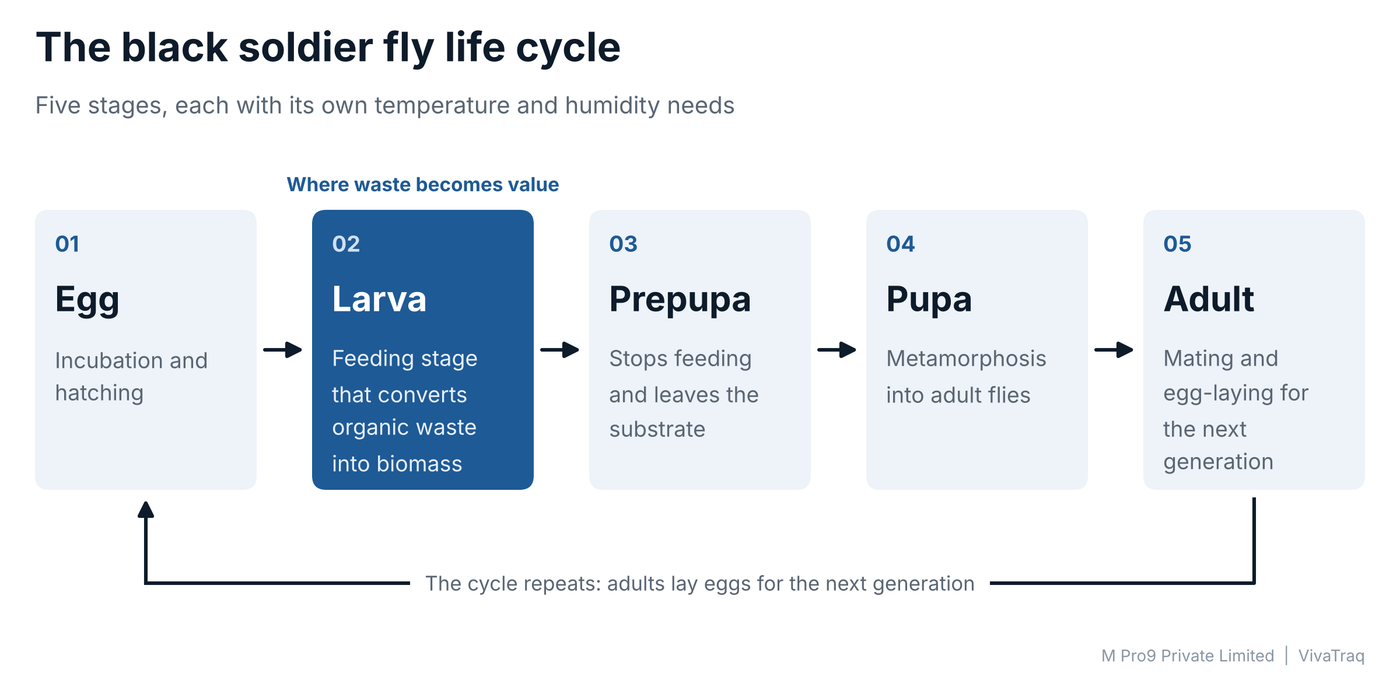
Five life stages, five different environments
| Life stage | What happens | Environmental focus |
|---|---|---|
| Egg | Eggs incubate and hatch into tiny larvae | Steady warmth and the highest humidity of the cycle |
| Larva | The feeding stage, where organic waste is converted into biomass | Warm, moist and well-ventilated conditions |
| Prepupa | Larvae stop feeding and migrate out of the substrate | Moderate warmth with comparatively drier conditions |
| Pupa | Metamorphosis into adult flies | Stable, moderate warmth and lower humidity |
| Adult | Flies mate and lay eggs to restart the cycle | Warmth with moderate humidity |
Why manual monitoring falls short
In many small and mid-sized BSF setups, conditions are still checked by hand with separate instruments. That approach creates several practical problems:
- Round-the-clock observation is difficult, so conditions can drift out of range between checks.
- Corrective action is delayed until someone notices the problem.
- Heaters, humidifiers and fans need constant attention to switch on and off at the right time.
- Managers have little remote visibility of what is happening inside the rearing unit.
- Accurate historical records are hard to maintain manually.
What BSF operations need is a system that monitors conditions continuously and responds automatically, while keeping people informed and in control.
Introducing VivaTraq: IoT-based automation for BSF rearing
VivaTraq is M Pro9’s answer to this challenge. It brings environmental sensors, an on-site smart controller, automatically switched climate devices, secure cloud services and a mobile application together into one connected system, designed specifically for black soldier fly rearing.
Instead of waiting for someone to notice a problem, VivaTraq watches the rearing chamber continuously, corrects conditions on its own and keeps the operator informed at every step.
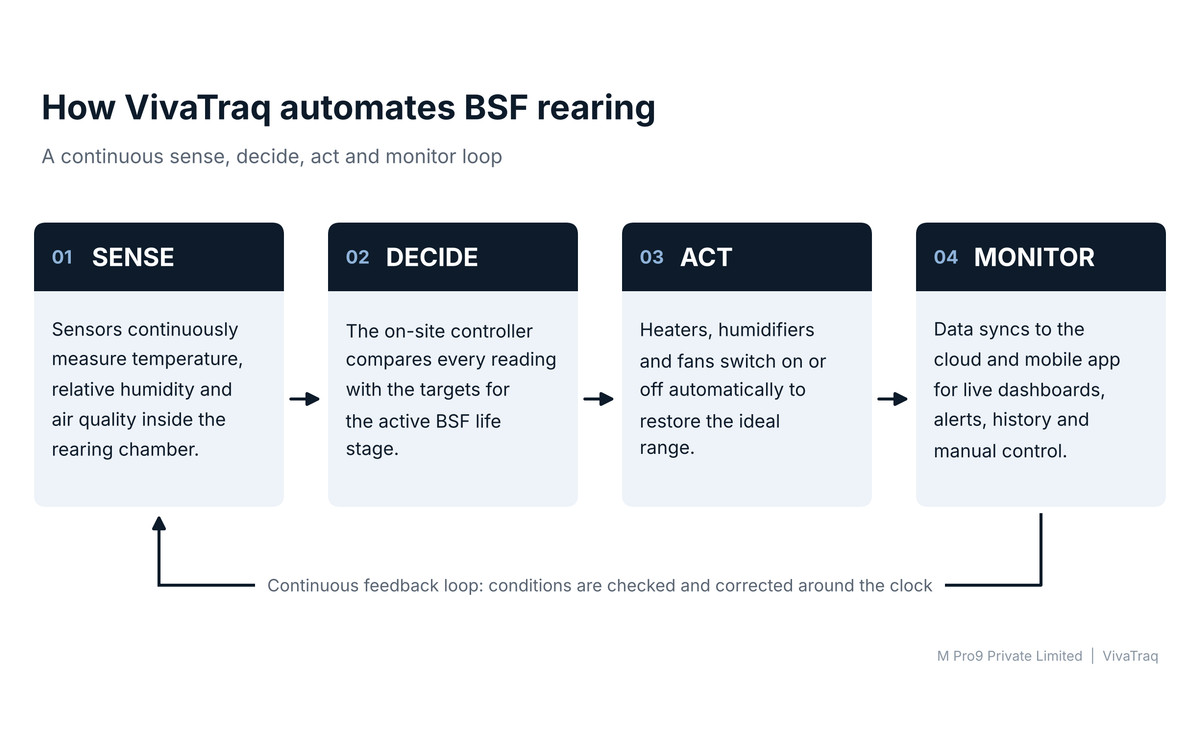
How VivaTraq works: sense, decide, act, monitor
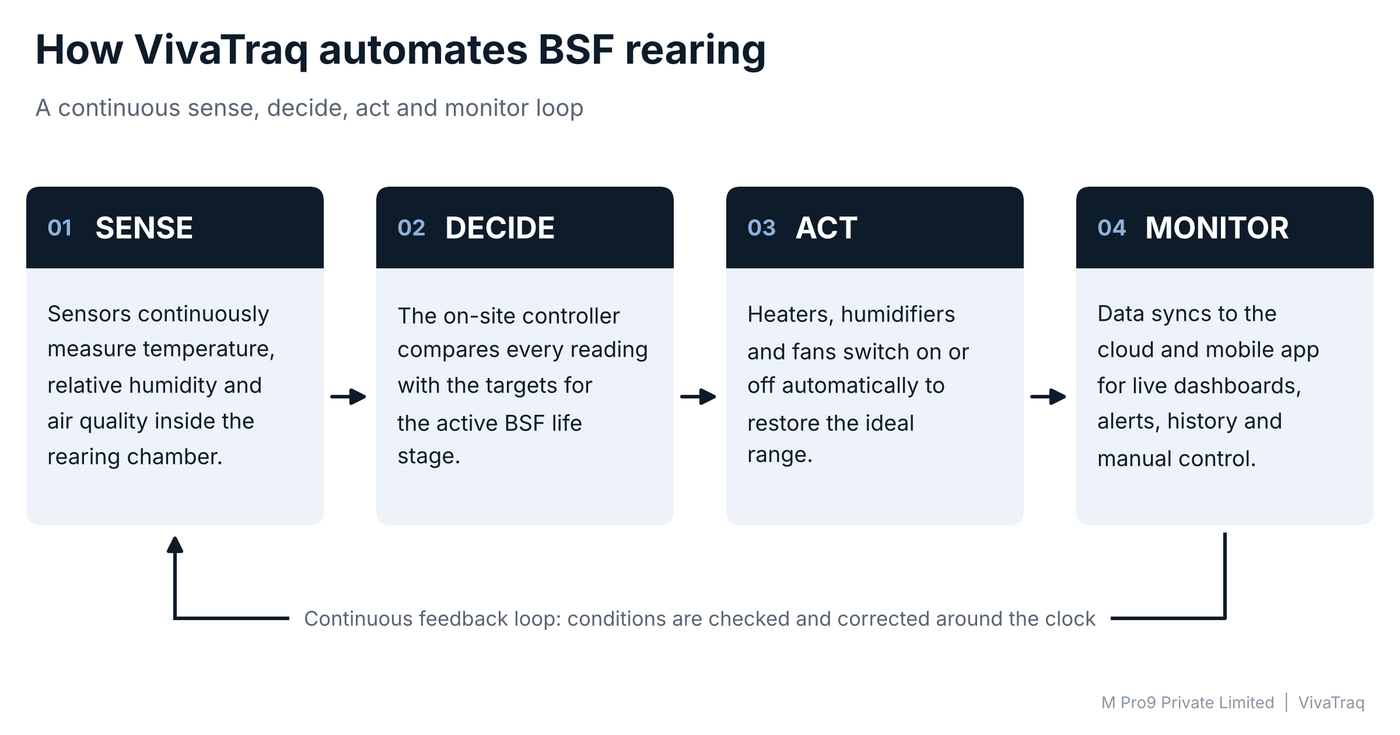
- Sense: Sensors inside the chamber continuously measure temperature, relative humidity and air quality.
- Decide: The on-site controller compares each reading with the target range for the BSF life stage that is currently active.
- Act: When conditions drift, it automatically switches the heating source, humidifier and ventilation, exhaust and cooling fans to bring the environment back into range.
- Monitor: Live readings, device status and time-stamped history sync to the cloud and appear in the VivaTraq mobile app, where operators can adjust targets or take manual control.
Key features that make BSF rearing smarter
Stage-based environmental management
Operators select the current BSF stage (egg, larva, prepupa, pupa or adult) and VivaTraq applies the matching temperature and humidity targets. Targets can be fine-tuned from the app as the colony moves from one stage to the next.
Automatic and manual control modes
In automatic mode, VivaTraq manages heating, humidification and airflow on its own. In manual mode, operators switch individual devices directly from their phone, and the automation steps aside until it is turned back on.
Real-time dashboard and trend charts
A clean dashboard shows the active stage, temperature, humidity, air-quality status, trend graphs and a log of recent actions, so the state of the chamber is clear at a glance.
Smart alerts and push notifications
VivaTraq notifies users about temperature, humidity, gas and device-related conditions, helping teams respond before small deviations become costly problems.
Historical data for better decisions
Environmental readings are stored as time-stamped records, building a data history that helps teams understand trends and refine their rearing practices over time.
Built-in safeguards and secure access
Heating, humidification and ventilation are coordinated so they complement rather than counteract each other. If a sensor reading is invalid or the selected stage is not recognized, automated outputs move to a safe state instead of acting on unreliable data. The controller is designed to keep running through network interruptions and to reconnect automatically, and secure sign-in ensures that only authorized team members can view data or operate devices.
From prototype to live BSF trials
We developed VivaTraq in deliberate stages: defining the environmental requirements, building and integrating the hardware, developing the control firmware and mobile app, connecting everything through the cloud, and then testing the complete system end to end.
Before introducing live insects, our team validated the platform with a fast-responding biological model: basil seeds grown inside the prototype chamber. We programmed a sequence of growth stages, starting with warm, humid conditions for germination and moving to drier conditions as the seedlings developed, and updated the targets through the mobile app as each stage began. The results were encouraging:
- The chamber responded to each change in targets sent from the app.
- Temperature and humidity stayed largely within the configured ranges during observed operation.
- Air-quality status remained normal throughout, and remote monitoring worked as intended.
- Sprouting appeared within the first few days, and more seedlings emerged over the days that followed.
This proof of concept was designed to validate the monitoring and control platform, not to stand in for BSF results. With prototype validation complete, VivaTraq is now progressing into trials with live black soldier fly colonies, where real-world observations will guide further refinement of the automation.
Benefits for BSF farmers, entrepreneurs and waste processors
- Consistent conditions: stage-specific targets reduce guesswork across the entire life cycle.
- Less manual effort: no more switching heaters, humidifiers and fans by hand around the clock.
- Faster response: continuous sensing and instant alerts catch deviations early.
- Remote visibility: check and control the chamber from anywhere through the mobile app.
- Data-driven improvement: historical records support better rearing decisions over time.
- Room to scale: an architecture designed to grow from a pilot chamber toward commercial facilities.
What’s next: scaling smart BSF farming in India and beyond
VivaTraq is being built as a foundation for larger, commercial-scale BSF operations. Our roadmap includes:
- Larger rearing chambers suited to industrial BSF production
- Expanded, higher-accuracy sensing for richer environmental insight
- Advanced analytics on long-term data to uncover patterns in BSF growth
- Automation refined using results from live BSF trials
- Enhanced remote monitoring and reporting
- Broader rollout of the VivaTraq mobile app
- Deployment in commercial BSF farms and waste-management operations
About M Pro9
M Pro9 Private Limited is an intelligent technology solutions company with offices in Mysuru, India and Dubai, UAE. We combine artificial intelligence, embedded systems and IoT, cloud and mobile development, and research-driven engineering to build practical, scalable and future-ready solutions to real-world challenges. In October 2026, M Pro9 received the AI & Technology Excellence Award at the IBS Awards 2026 in Dubai.
VivaTraq reflects that multidisciplinary approach, bringing hardware, firmware, cloud and app development together to make sustainable BSF farming easier to run and easier to scale.
Planning or scaling a BSF facility?
Talk to M Pro9 about smart environmental monitoring and automation for black soldier fly rearing. Email info@mpro9.com or get in touch with our team.
References
- United Nations Environment Programme (2024). Food Waste Index Report 2024. unep.org/resources/publication/food-waste-index-report-2024
- Feedipedia (INRAE, CIRAD, AFZ and FAO). Black soldier fly larvae (Hermetia illucens), dehydrated. feedipedia.review.fao.org/node/17132
- El Deen, S. N. et al. (2023). Bioconversion of different waste streams of animal and vegetal origin and manure by black soldier fly larvae Hermetia illucens L. (Diptera: Stratiomyidae). Insects, 14(2), 204. doi.org/10.3390/insects14020204
- Arabzadeh, G. et al. (2022). Diet composition influences growth performance, bioconversion of black soldier fly larvae: agronomic value and in vitro biofungicidal activity of derived frass. FAO AGRIS record. agris.fao.org/search/en/records/67598af7c7a957febdfb9c92