Why Choosing the Right Developer Matters
Somewhere in Mysuru this week, a business owner is having the same conversation for the third time. She runs a showroom the family has held for decades. Walk-in customers still arrive on reputation, but the younger ones check Google first. So she has decided to get a website built. She has spoken to three people, and now has three very different prices, three very different timelines, and no reliable way of telling whether they are even quoting for the same thing.
That is the real difficulty. Capable developers are not scarce. The trouble is that a website looks like one product from outside, when it is actually a bundle of separate decisions — design, hosting, content management, speed, mobile behaviour, security, search readiness and maintenance. Two quotations can differ enormously and both be honest, because they describe different products.
A website is rarely the reason someone buys from you. It is very often the reason someone decides not to.
- First impressions. Visitors judge within seconds. Text overflowing on a phone reads as carelessness, fairly or not.
- Customer trust. Clear contact details, a working enquiry form and a valid security certificate do more for credibility than decoration.
- Search visibility. Heading structure, titles, URLs and clean code decide whether Google understands your pages — development decisions, not marketing ones taken later.
- Lead generation. A site that does not tell visitors what to do next collects admiration instead of enquiries.
- Mobile users. For most local businesses, most traffic arrives on a phone. A site checked only on a laptop disappoints most of the people who see it.
- Long-term maintenance. Plugins need updating and certificates expire. Who does that work, and on what terms, should be settled before you sign.
Twelve Things to Look For
Each with a question worth asking directly.
- Experience and portfolio. Open the live sites, not screenshots. Ask: which of these did you build end to end, and which did you only design?
- Understanding of your business. A good developer asks about your customers and enquiry process before discussing colours. Ask: what should our website's main job be?
- Responsive, mobile-first design. Built for the small screen first and expanded upwards. Ask: can I see a recent site of yours on my own phone right now?
- SEO-friendly development. Heading hierarchy, unique titles and descriptions, readable URLs, alt text, sitemap and robots file. Ask: what SEO groundwork is included in the build itself?
- Speed and performance. Compressed images, modern formats, minimal scripts, caching. Ask: what load time are you targeting on mobile, and how will we measure it?
- Security and backups. SSL, secure admin access, updates, and backups stored off the main server. Ask: how often are backups taken, where are they kept, and how fast can you restore?
- Content management. Decide honestly whether your team will update the site. Ask: which pages can I edit myself?
- Scalability. Today it is eight pages; in two years it may need a catalogue, payments or a customer login. Ask: what would it take to add e-commerce later?
- Communication and support. One point of contact and written summaries prevent most disputes. Ask: who will I speak with, and how often will I see progress?
- Transparent pricing. Deliverables, page count, revision rounds, exclusions and recurring costs. Ask: what is not included in this price?
- Ownership of website, domain and hosting. The most commonly ignored point, and the most expensive to fix. Ask: will the domain be registered in my business's name, and will I receive hosting credentials and source files?
- Post-launch maintenance. Ask: what happens on day 31 after launch?
One clarification: locally, “website design company” and “web development company” are advertised as the same thing. Design covers layout and user experience; development covers code, CMS, integrations, security and performance. Confirm which you are buying, and who owns the other half.
Freelance Developer or Development Company?
Both routes work. They fail in different ways, and the right choice depends on the size and lifespan of what you are building.
| Consideration | Freelance developer | Development company |
|---|---|---|
| Cost | Usually lower | Usually higher |
| Speed on small projects | Often faster | Process adds overhead |
| Access to the builder | Very high | Via a coordinator or lead |
| Range of skills | Strong in one or two areas | Design, development, SEO and QA in one team |
| Handling scope growth | Can become a bottleneck | Absorbed more easily |
| Availability during illness | Single point of failure | Cover available |
| Long-term support | Depends on their situation | Contractual, if agreed in writing |
| Documentation and handover | Varies widely | Usually structured |
A capable freelancer suits a compact site with clear scope and a modest budget, especially if someone internally can manage the project. A company makes more sense with integrations, several stakeholders, a long maintenance horizon, or when downtime carries a real cost. What matters more than the label is written scope, written ownership terms and demonstrable past work.
What Drives the Cost
We have deliberately not printed price bands. Quoting a figure without knowing the scope is how business owners end up comparing incomparable proposals. What is useful is knowing which variables move the price.
| Cost driver | What increases the cost |
|---|---|
| Number of pages | More unique page layouts, not merely more content |
| Design requirements | Custom design and illustration versus a customised template |
| CMS or custom development | Custom-built modules and workflows versus a standard CMS |
| E-commerce | Catalogue size, variants, payment gateway, shipping and tax logic |
| Integrations | CRM, ERP, WhatsApp Business, payments, booking, enquiry routing |
| SEO requirements | On-page groundwork versus keyword research and location pages |
| Content creation | Whether you supply text and photographs, or the developer produces them |
| Maintenance | Update frequency, response commitments, backup and security cover |
| Hosting and domain | Shared hosting versus higher-specification hosting |
Two practical points. Ask every developer to quote against the same written requirement list, or you are comparing guesses. And ask which costs recur annually — domain, hosting, SSL, plugin licences, maintenance. A low build price attached to a heavy annual commitment is not affordable; it is a deferred cost. Judge it across three years, not at the first invoice.
Ten Questions to Ask Before Hiring
- Can I see your previous projects? Live URLs, and your specific role in each.
- Will the website be mobile-friendly? Ask them to open a past project on your phone.
- Will it be SEO-friendly? Ask what is in the build versus a separate SEO retainer.
- Who owns the website and source files? Get the answer in writing.
- Will I receive domain and hosting access? Full credentials, in your business's name.
- Is maintenance included? For how long, covering what, and at what cost afterwards.
- What happens after launch? Training, documentation, bug-fix window, response times.
- How long will development take? With milestones, and what causes delays.
- What technologies will be used? And how common they are, so another developer could take over.
- What is included in the quotation? And, equally important, what is excluded.
Red Flags to Watch For
- An unusually low quotation with no defined scope. Cheap normally means a recycled template, stock content and no maintenance — and the gap surfaces later.
- No portfolio, or only design mockups. Mockups are not evidence that someone can build and launch a working site.
- No written quotation. Verbal scope is the root cause of most website disputes.
- Domain or hosting registered in the developer's name. This turns a supplier relationship into a dependency and makes leaving expensive.
- No mobile version discussed. If phones do not come up unprompted, they were not planned for.
- No mention of SEO basics. Titles, headings, URL structure and alt text are part of building, not extras.
- No security or backup plan. Ask where backups are stored. “On the same server” is not a backup.
- Slow or vague communication before payment. It will not improve after payment.
- No post-launch support terms. Ask what happens the first time something breaks on a Sunday.
A Checklist You Can Use
Before you shortlist
- Written down the website's main job — enquiries, bookings, credibility or sales
- Listed required pages and any integrations
- Decided whether your team will update content
- Prepared one requirement brief to send to every developer
While evaluating
- Opened at least three of their live sites on a phone
- Confirmed who designs and who builds
- Asked what SEO groundwork is included
- Asked about page speed targets and how they are measured
- Asked about SSL, backups and the update policy
- Confirmed CMS access and which pages you can edit
Before signing
- Domain to be registered in your business's name
- Hosting credentials to be handed over
- Source files and design assets to be handed over
- Written quotation listing inclusions, exclusions and revision rounds
- All recurring annual costs listed
- Timeline with milestones agreed
- Post-launch support period and terms agreed in writing
Why a Mysuru-Based Partner?
A local partner is not automatically a better one — a skilled remote team with strong process can outperform a nearby team without one. But proximity earns its place in specific situations.
- Easier communication. Shared language and working hours, and misunderstandings resolved in one conversation rather than four emails.
- Local search understanding. Many people still use the older spelling, so a website development company in Mysore and one in Mysuru are the same thing to a customer — and both spellings matter when structuring location pages and your Google Business Profile.
- In-person discussions. Useful for content and photography for showrooms, hotels, clinics and institutions, where someone must see the premises to represent it properly.
- Understanding of local markets. Dasara season, tourism cycles and the education calendar shape what a website should emphasise, and when.
- Faster coordination. Shorter feedback loops during launch week, when small delays cost the most.
Where local matters least is technical capability. Judge portfolio, process and written terms first, and treat proximity as an advantage rather than the deciding factor.
How M PRO9 Builds Websites
M PRO9 is an intelligent technology solutions company based in Mysuru, working with businesses, startups, professionals, institutions and organisations. Website development forms one part of the work, alongside software and application development and product engineering.
The approach is straightforward: understand the requirement before writing any code. Before design begins we establish who the website is for, what a successful visit looks like, what the enquiry journey should be, and what the business can realistically maintain afterwards. A website nobody in the organisation can update stops being useful within a year.
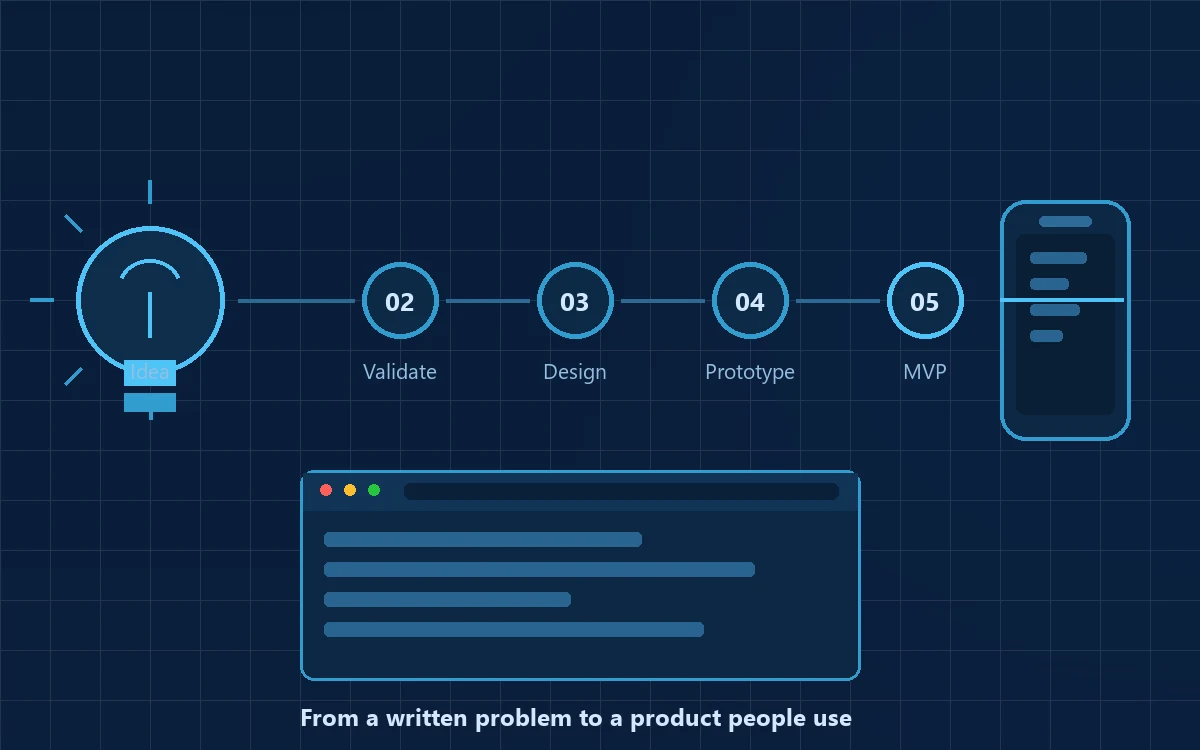
- Requirement — business goals, audience, competitor review, page and feature list
- Planning — sitemap, content plan, technology and hosting decisions, timeline
- UI/UX — wireframes and visual design, reviewed on mobile as well as desktop
- Development — responsive build, with SEO groundwork, security and performance handled during the build
- Testing — cross-browser and cross-device checks, forms, speed, pre-launch SEO validation
- Launch — deployment, analytics and Search Console setup, indexing checks
- Support — handover of credentials and source files, training, and an agreed maintenance arrangement
Sites are built responsive, fast and structured for search from the outset, so SEO-friendly development is part of the build rather than a separate project bolted on later. Ownership is simple: the domain is registered in your business's name, and you receive hosting access and source files. You can see recent work on our work page.
Conclusion
Choosing a website developer is not really a technical decision. It is a judgement about scope, ownership and accountability — three things you can assess without knowing a single line of code.
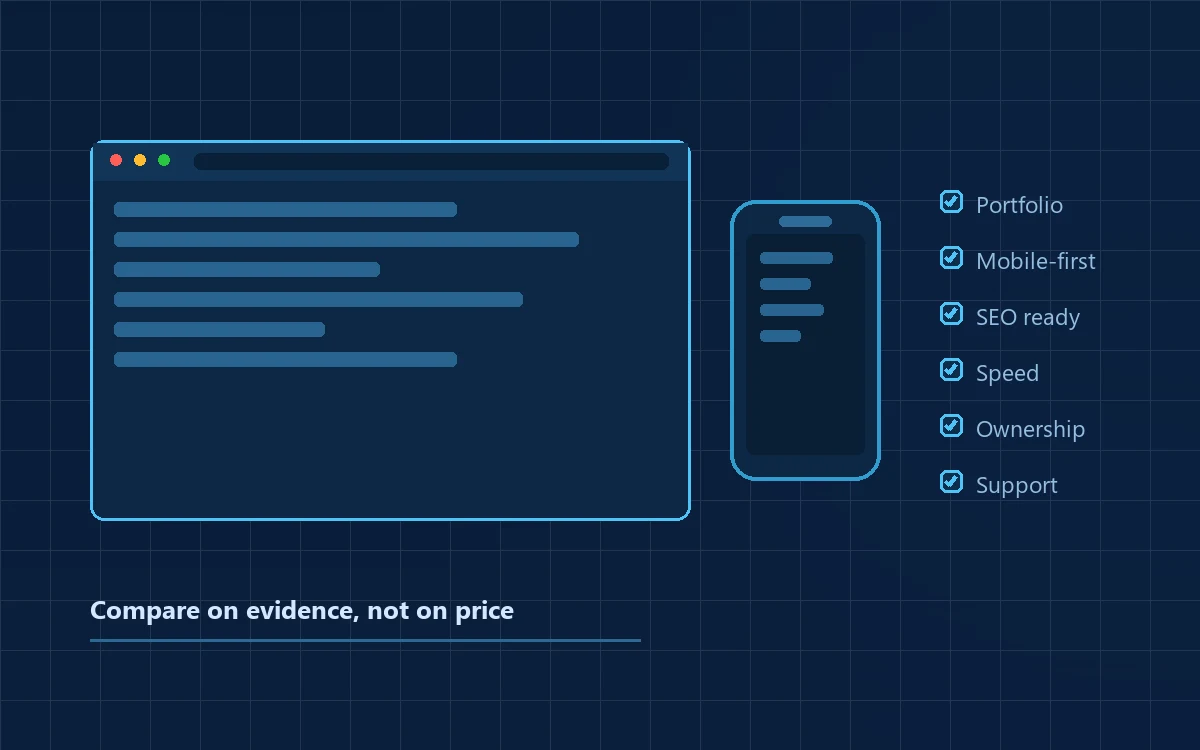
Compare candidates on live portfolio work rather than promises. Insist on a written quotation that states exclusions as clearly as inclusions. Confirm the domain will be registered in your business's name and that you will receive hosting access and source files. Check that mobile performance, speed, security and basic SEO are part of the build. And settle what happens after launch, before launch.
Price matters, but it is the last filter, not the first. The most expensive website is the one rebuilt in eighteen months because nobody asked the right questions at the start. A capable partner will welcome these questions — clear expectations make for better projects on both sides. If you are weighing up the technical approach as well, our comparison of static and dynamic websites covers that choice in detail.